
Millet Flours vs Wheat Flour – Taste, Texture & Cooking Behaviour

Key Highlights
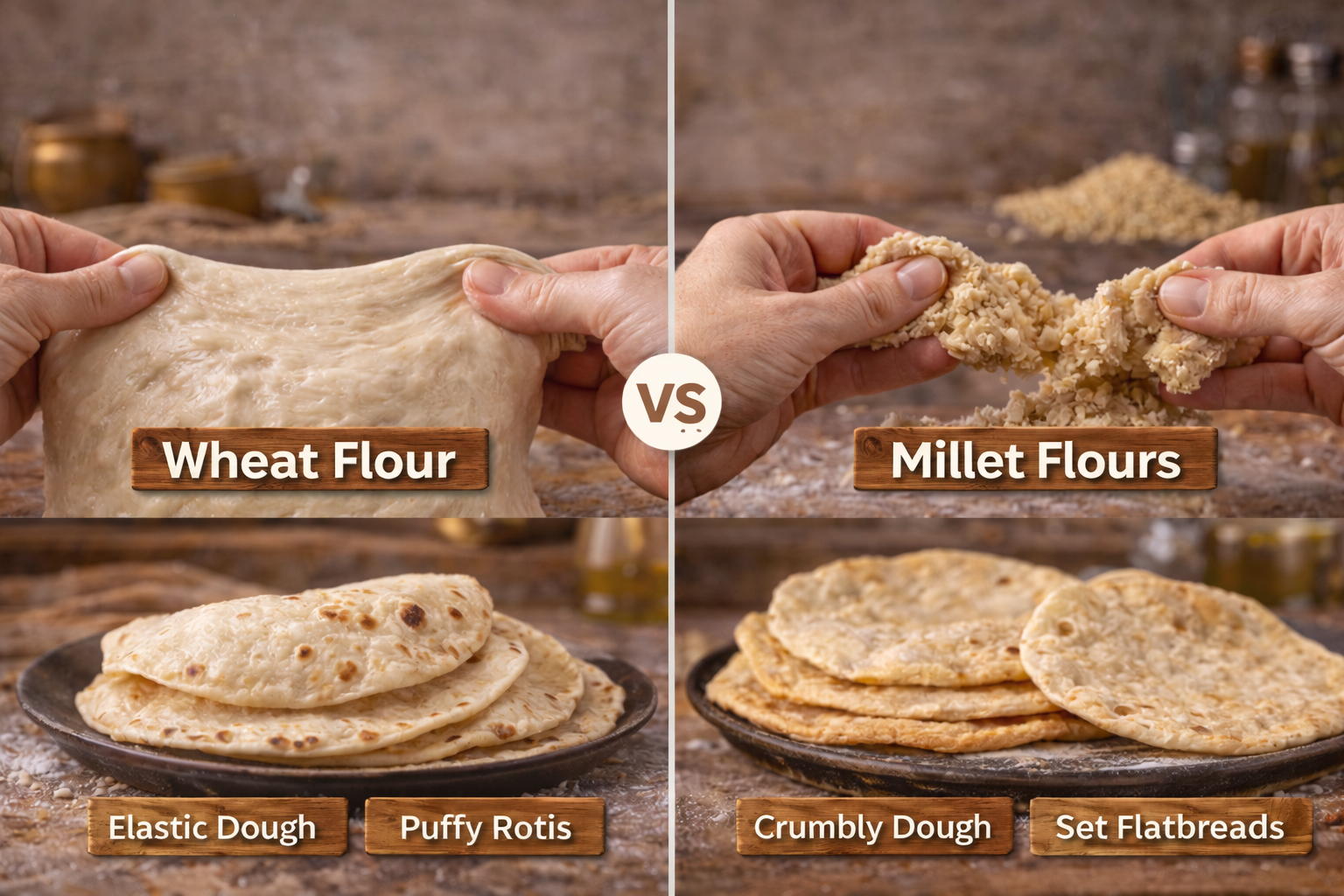
- Wheat flour stretches; millet flours set with heat
- Millet flours have natural flavour, not neutrality
- Texture differences show up after cooking, not kneading
- Stop treating millets like wheat substitutes
Put wheat flour and millet flour next to each other on your kitchen counter, and they don’t look that different. Both are flours. Both turn into dough. Both can make rotis and flatbreads.
But the moment you add water, the difference becomes clear.
This is where most confusion begins not because millet flours are difficult, but because we expect them to behave like wheat flour. And wheat flour has trained us very well over the years.
The First Five Minutes Tell You Everything
Mix wheat flour with water and start kneading.
It comes together quickly.
It stretches.
It smooths out.
Wheat flour likes being handled. It responds immediately and predictably.
Now do the same with millet flours like barnyard millet flour, foxtail millet flour, or little millet flour.
The dough forms, but it feels different. Softer, less elastic, sometimes slightly fragile. When you pull it, it doesn’t stretch back.
That’s usually the moment people decide millet flours are “tricky”.
They’re not. They’re just not stretchy.
Stretch vs Set: The Real Difference
Wheat flour relies on gluten. Gluten works like tiny rubber bands inside the dough, allowing it to stretch, bounce back, and forgive rough handling.
Millet flours don’t contain gluten.
Instead of stretching, they set when properly hydrated and heated. Their strength comes from water absorption and cooking temperature, not elasticity.
This is why millet dough often feels underwhelming in your hands but performs beautifully on the pan. The structure develops during cooking, not during kneading.
The magic happens with heat.
Taste: Wheat Steps Back, Millets Step Forward
Wheat flour is neutral. It stays quiet and lets whatever you’re cooking take centre stage.
Millet flours are more present.
Each one brings its own subtle flavour:
- Foxtail millet flour has a mild nuttiness
- Kodo millet flour feels earthy and grounding
- Proso millet flour is gentle and slightly sweet
- Barnyard millet flour sits somewhere in between
These flavours don’t overpower a dish, but they don’t disappear either. That’s why food made with millet flours often tastes fuller, even with simple seasoning.
You’re not adding more flavour. The flour is simply contributing its own.
Why Millet Dough Feels “Wrong” (But Isn’t)
This is where most people get stuck.
Millet dough is often judged using wheat standards — stretch, smoothness, bounce. By those measures, it can feel disappointing.
But millet dough isn’t trying to impress you at that stage.
What it actually needs is:
- Enough water
- Enough resting time
- Gentle handling
Once cooked, millet-based rotis and flatbreads soften, settle, and hold together naturally. The texture makes sense on the plate, even if it felt unfamiliar in the bowl.
This is also why resting matters more with millet flours than with wheat flour.
Why All Millet Flours Don’t Behave the Same Way
Even within millet flours, behaviour isn’t identical.
Some, like barnyard millet flour and foxtail millet flour, hydrate more evenly and cook into a softer texture when rested well. Others, such as kodo millet flour and proso millet flour, feel firmer and need careful hydration to avoid dryness.
Little millet flour often falls somewhere in between, producing a tender bite once cooked.
What they all share is this: none of them stretch like wheat flour. Their structure depends on hydration and heat, not elasticity.
Once you stop expecting millet flours to behave like wheat — or even like each other — cooking becomes far more predictable.
Cooking Behaviour: Judge After Cooking, Not Before
Here’s a simple mindset shift that helps immediately:
Don’t judge millet flours while kneading.
Judge them after cooking.
Millet rotis:
- Don’t bounce like wheat
- Feel softer once cooked
- Have a gentle bite rather than chew
This texture is intentional. It’s not a flaw.
Traditional kitchens have always understood this, which is why millet flours were never treated as wheat substitutes. They were treated as their own ingredients.
Think Less “Replacement”, More “Rotation”
Millet flours aren’t trying to replace wheat flour.
They’re meant to sit alongside it.
Some days you want stretch and familiarity — wheat does that well.
Some days you want depth, softness, and a different mouthfeel — that’s where millet flours shine.
Once you stop forcing millet flours to behave like wheat, they become surprisingly easy to cook with.
This article is part of our larger guide on Organic Flour in the UAE – How Texture, Absorption & Taste Really Change Cooking, where we explain the full picture.
Frequently Asked Questions
1. Why does millet dough feel fragile compared to wheat?
Because it doesn’t rely on gluten for strength. Its structure develops with heat, not stretch.
2. Do millet flours need different recipes?
Mostly no. They need different expectations, proper hydration, and resting time.
3. Will millet rotis ever feel like wheat rotis?
No — and they’re not meant to. The texture is intentionally different.
4. Is it normal for millet flours to taste more grainy?
Yes. That natural grain taste is part of their character.